
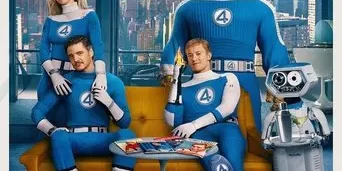
Fantastic Four Review – is it fanatastic?
CRITICS SCORE

Full Review
Marvel’s Fantastic Four (2025) finally introduces the iconic team into the MCU proper, and for the most part, it delivers. It’s visually stunning, well-cast, and ambitious especially with its choice of Galactus as the main villain and a gender-flipped Silver Surfer. But while the film plants some big seeds for Marvel’s future, it also highlights a few of the problems still lingering in the post-Endgame MCU.
Right off the bat, the cast is locked in. Pedro Pascal brings a steady, almost weary intelligence to Reed Richards, which works well for a man shouldering the weight of multiple realities. Vanessa Kirby is excellent as Sue Storm capable, emotionally complex, and more central to the story than any previous version. Johnny (Joseph Quinn) and Ben (Ebon Moss-Bachrach) round out the team with a grounded, lived-in chemistry that feels natural and believable.
The film doesn’t waste time on origin stories. The team already has their powers, and they’re thrust into the cosmic deep end when they make contact with the Herald of Galactus: a reimagined Silver Surfer, this time played by a woman (Sofia Boutella). And she’s great stoic but conflicted, more of a tragic figure than a full antagonist. It was entertaining to have that connection between johnny and her that wasnt really a love story but a interested connection that helped push the storyline.
Galactus himself is visually incredible. He’s portrayed more like a cosmic force of nature than a traditional villain a massive, unknowable entity who consumes planets out of balance. The design leans into abstract Kirby-esque visuals, and while he only speaks a handful of times, it’s effective. He feels less like a character and more like an inevitable doom, which works in his favor.
While Fantastic Four looks and feels bigger than recent Marvel entries, there’s still a sense that the MCU doesn’t quite know what it wants to be. There are emotional beats that don’t land as hard as they could, and while Galactus is impressive, his motivations are kept vague almost too vague. The film flirts with big ideas about balance, cosmic judgment, and existential sacrifice, but doesn’t fully explore them.
Also, the pacing can feel rushed. The middle act is jam-packed with exposition about the multiverse, cosmic warnings, and incursions all things Marvel has been teasing for a while now. At some point, it starts to feel like homework. The Fantastic Four are compelling enough on their own that the movie didn’t need to be bogged down by broader MCU setup.
And then there’s the end credit scene everyone will be talking about. A cloaked figure with the famous green cap holding the famous Dr doom mask playing with franklin Richards. The scene cut without out us seeing his face, which we will assume is Rodney Downy Jr. It is underwhelming and there should of been more. We also were left with questions from the last scene in the thunderbolts where the fantastic four ship appears from a portal heading to earth. The end credits did state next time we will see fantastic four with be in Avengers doomsday. So we will see how it all ties in together.
Fantastic Four (2025) is a much-needed win for Marvel. It introduces the team with style, gives us a Galactus who actually feels worthy of the hype, and tees up Doctor Doom as the next big threat. The movie isn’t perfect—it’s heavy on setup, light on payoff in a few spots but it’s easily one of Marvel’s most promising Phase 5/6 entries.
The big swings (female Silver Surfer, Galactus as an existential threat, Doom’s long-awaited arrival) mostly connect. Now it’s just a matter of Marvel following through. No more stalling.